
Appraisal vs. Market Value vs. Online Estimate: Three Numbers That Do Not Mean the Same Thing
Updated: Sep 25

A homeowner opens a real estate website and sees an estimated value of $615,000.
A real estate agent reviews the property and recommends listing at $599,000.
A buyer offers $605,000.
The lender's appraisal later comes in at $600,000.
Which number is the home's real value?
That question sounds simple, but it mixes together several different concepts.
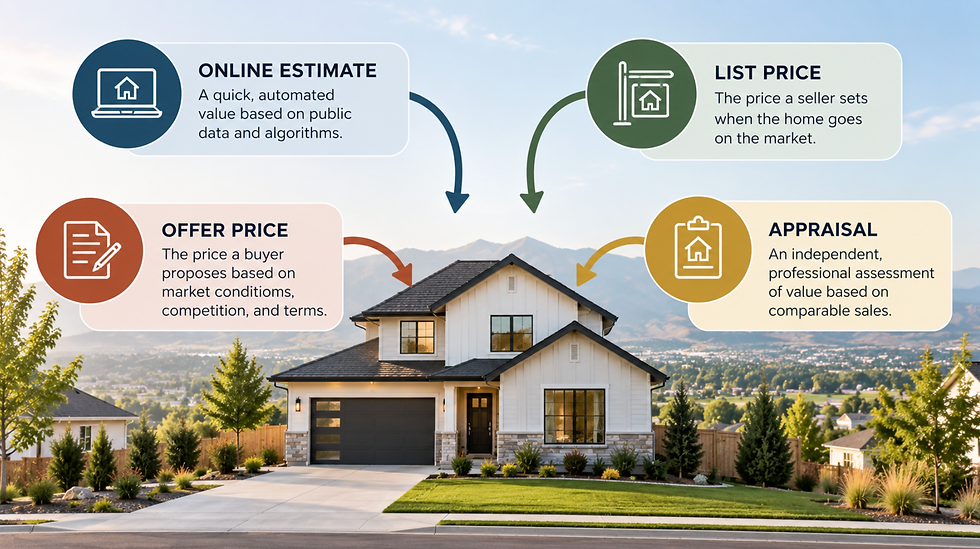
An online automated estimate, a real estate pricing analysis, a contract price, and an appraisal are not competing versions of the same calculation. They are different tools created for different purposes.
For Treasure Valley buyers and sellers, understanding that difference can prevent bad pricing decisions and unnecessary panic during financing.
Start With the Most Important Concept: Value Is Contextual
Real estate does not have one permanent price stamped on it.
A home's probable sale price changes with:
Market conditions
Competing inventory
Interest rates and financing conditions
Property condition
Location
Lot characteristics
Buyer demand
Seller motivation
Concessions
Timing
The same home could reasonably produce different values at different points in the year.
That does not mean valuation is random. It means the analysis has to match the question being asked.
Online Estimates: Fast, Useful, and Incomplete
Automated valuation models use large datasets to estimate property value.
Depending on the platform, they may consider:
Public records
Prior sales
Nearby sales
Property characteristics
Market trends
Listing information
Their biggest advantage is speed. A homeowner can get a number in seconds.
Their limitation is that a model may not fully understand the property the way a person standing inside it does.
For example, an automated system may have difficulty accurately pricing differences such as:
Premium view
Interior remodel quality
Backyard privacy
RV garage
Poor floor plan
Backing to a busy road
Irrigation or acreage features
Deferred maintenance
Superior subdivision location
Major unreported improvements
Online estimates are useful as a starting point. They are not a substitute for a property-specific pricing analysis.
A Real Estate Pricing Analysis: What Is the Market Likely to Do?
A comparative market analysis, or CMA, is typically prepared by a real estate professional to help a seller decide how to position the home or help a buyer evaluate an offer. A strong analysis goes beyond recent closed sales.
It should consider:
Sold properties
What has the market already proven buyers would pay?
Pending properties
What homes successfully attracted buyers recently?
The final sale price may not yet be public, but the listing history and time to contract can still provide context.
Active competition
What can a buyer purchase instead of your home today?
This matters enormously.
A home does not compete only with last month's sales. It competes with today's choices.
Failed or stale listings
Which homes sat on the market, expired, or required repeated reductions?
Those listings can show where buyers rejected the seller's pricing thesis.
Property-specific differences
Lot, condition, age, updates, garage, location, view, floor plan, HOA, and other characteristics should influence the range.
The purpose of a CMA is usually strategic:
What price positions the property to achieve the seller's goal in the current market?
That is different from an appraisal assignment.
An Appraisal: An Independent Opinion for the Lending Process
For many financed transactions, the lender obtains an appraisal to support its underwriting decision.
Fannie Mae describes the appraisal as an independent, objective opinion of market value used by lenders in evaluating collateral.
The appraiser analyzes the subject property and market evidence using professional standards and the scope required for the assignment.
The appraisal may consider:
Comparable sales
Market conditions
Property condition
Site characteristics
Quality
Adjustments for relevant differences
Contract details
The appraiser is not hired to validate the seller's list price or make the buyer happy. The appraiser's role is different from the agent's role.
The Contract Price Is Another Important Number
The price a buyer and seller agree to is evidence of the market, but it is not automatically the same as appraised value.
A contract can be influenced by:
Multiple offers
Seller concessions
Closing-cost credits
Personal property
Repair agreements
Unique buyer motivation
Seller urgency
Financing terms
Two buyers can value the same property differently. The accepted offer tells you what one buyer and one seller agreed to under those specific terms.
Why the Numbers Can Be Different Without Anyone Being Wrong
Imagine a Meridian home with an online estimate of $620,000.
The seller wants $625,000.
Current competing homes are sitting between $595,000 and $610,000.
Recent comparable sales support roughly $600,000 to $610,000.
The agent recommends $609,900.
A buyer offers $605,000 with a closing-cost credit.
The appraisal comes in at $600,000.
That sequence does not prove that the online estimate was "wrong" and the appraiser was "right."
It shows that each number came from a different method, date, and purpose.
What matters is how the number affects your decision.
Sellers: Do Not Build a Pricing Strategy Around the Highest Number You Can Find
A common seller mistake is collecting estimates until one confirms the price they already wanted.
Instead, ask:
What are buyers comparing us against today?
What recent sales are genuinely similar?
How much inventory exists in our price bracket?
How long are comparable homes taking to sell?
What concessions are competing sellers offering?
Does new construction compete with us?
What happens if we miss the first three weeks of buyer attention?
The purpose of pricing is not to win an argument about theoretical value.
It is to achieve the seller's objective.
Buyers: An Appraisal Is Not a Property Inspection
An appraisal and home inspection serve different purposes.
The appraiser evaluates the property for the valuation assignment and applicable lender requirements.
A home inspector evaluates visible property conditions within the scope of the inspection. Do not skip an inspection because the property appraised.
A house can appraise at the contract price and still have a roof problem, sewer issue, drainage concern, or other defect.
What Happens if the Appraisal Is Below the Contract Price?
The answer depends on the purchase agreement, financing, and negotiation.
Possible outcomes can include:
Buyer and seller renegotiate the price
Buyer brings additional cash
Seller reduces the price
Parties split the difference
Appraisal is reviewed or reconsidered through the lender's process
The transaction proceeds under an appraisal-gap agreement
A contractual contingency may apply
Do not assume one outcome is automatic.
The contract controls the parties' rights and obligations.
Online Estimates Are Most Useful as a Trigger for Better Questions
Instead of asking:
"Is my online estimate accurate?"
Ask:
"What data is driving this estimate, and what property-specific information might it be missing?"
That question leads somewhere useful.
For an updated home, ask whether the improvements are reflected in public data.
For a home on acreage, ask whether the model understands the site and outbuildings.
For a new subdivision, ask whether builder incentives are affecting comparable sales.
For a home backing to a major road, ask whether nearby sales share that condition.
A Better Valuation Stack for Homeowners
If you want to understand your position, use several layers.
Layer 1: Automated estimate
Quick reference point.
Layer 2: Recent comparable sales
What the market has already done.
Layer 3: Active and pending competition
What buyers are choosing from now.
Layer 4: Property-specific condition and features
What makes your home meaningfully different.
Layer 5: Net proceeds
What you may actually keep after debt, concessions, and transaction costs.
The last number is often more useful than the first.
The Bottom Line
An online estimate is a model.
A listing analysis is a strategy tool.
An appraisal is a professional valuation assignment.
A contract price is the result of a negotiation.
They can all be different.
The mistake is treating them as interchangeable.
If you are thinking about selling in Boise, Meridian, Eagle, Star, Kuna, or elsewhere in the Treasure Valley, Defy Real Estate can prepare a property-specific pricing and net-sheet review that looks at the market buyers are actually seeing - not just the number an algorithm produced.



Comments